Market stability in 2026
The stablecoin market in 2026 remains heavily concentrated, with Tether (USDT) and USD Coin (USDC) controlling approximately 85% of the total market capitalization, which exceeds $300 billion. This dominance creates a dual-edged sword: while deep liquidity ensures smooth trading for most users, the sheer scale of these assets means that even minor stability issues can ripple through the broader crypto ecosystem. Understanding the baseline behavior of these two giants is essential for identifying when a stablecoin depeg event is merely a temporary glitch versus a systemic risk.
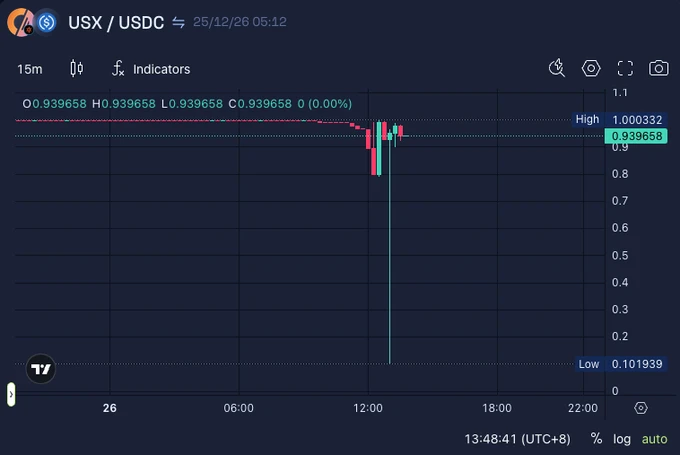
To visualize this stability, we can look at the recent trading performance of these assets. The following chart illustrates the price action of USDT/USD, showing how closely it tracks the dollar and highlighting any recent deviations that might signal underlying stress.
Depegging is rarely about a single price tick; it is about what a token is pegged to and how long deviations persist. For USDT and USDC, these deviations are typically short-lived, corrected by arbitrageurs who buy the discounted asset to restore the peg. However, the risk landscape is shifting. As regulatory scrutiny intensifies and market conditions evolve, the mechanisms that have historically kept these coins stable are facing new tests. Traders and investors need to monitor these price charts not just for profit, but as early warning systems for potential liquidity crunches or confidence crises.
New rules change reserve mechanics
The 2026 regulatory landscape has shifted from vague guidance to strict reserve requirements. Issuers must now hold high-quality liquid assets (HQLA) that are fully segregated from operational funds. This structural change is designed to prevent the commingling of funds that led to previous failures, but it creates new vectors for depegging if compliance is breached or reserves are frozen by authorities.
Regulators are demanding real-time auditability. Unlike previous years where quarterly reports sufficed, new frameworks often require proof of reserves (PoR) that can be verified on-chain or through approved third-party auditors. If an issuer cannot prove solvency instantly during market stress, a run on the stablecoin can trigger a rapid depeg, regardless of the underlying asset quality.
This environment penalizes opacity. Stablecoins that rely on commercial paper or less liquid corporate debt are facing existential pressure. The market is rapidly consolidating around issuers with transparent, short-duration government backing. Any deviation from these strict reserve standards is now viewed as an immediate risk signal by algorithmic arbitrageurs who enforce the peg.
USDT vs USDC stability
Tether (USDT) and Circle’s USDC dominate the stablecoin landscape, controlling roughly 85% of the market with a combined capitalization exceeding $300 billion. While both assets maintain their $1 peg through daily operations, their reserve structures and regulatory postures differ significantly. Understanding these mechanical differences is essential for assessing depeg risk in a shifting regulatory environment.
Reserve Composition and Transparency
Tether has transitioned from a controversial opaque model to a more structured reserve breakdown, though it still relies on a broader mix of assets than its primary competitor. According to Tether’s attestation reports, the majority of USDT reserves are held in US Treasury bills and cash equivalents, with smaller allocations in commercial paper and other instruments. This diversification aims to mitigate single-asset risk but introduces counterparty exposure to the commercial paper market.
Circle maintains a more conservative reserve strategy, predominantly backed by cash and short-duration US Treasury bills. Unlike Tether, Circle publishes monthly attestation reports rather than full audits, providing a clearer, albeit less detailed, view of its liabilities. This focus on high-quality, liquid assets is designed to ensure immediate redemption capacity, reducing the likelihood of liquidity-driven depegging events.
Regulatory Posture and Historical Resilience
The regulatory environment remains the primary differentiator between the two stablecoins. USDC operates under stricter compliance frameworks, with Circle actively engaging with US regulators and adhering to state money transmitter laws. This regulatory alignment has made USDC the preferred choice for institutional investors and regulated financial entities, though it also means Circle can freeze addresses under legal orders.
Tether operates with greater anonymity and less direct regulatory oversight, allowing for broader adoption in jurisdictions with capital controls. Historically, USDT has faced several depegging incidents, most notably in May 2022, when it dipped below $0.90 amid concerns over its reserve backing. The asset recovered quickly, but the event highlighted the importance of market confidence in maintaining the peg.
Comparative Analysis
The table below summarizes the key structural differences that influence stability risk.
| Feature | USDT | USDC |
|---|---|---|
| Primary Backing | US Treasuries, Cash, Commercial Paper | Cash, Short-Term US Treasuries |
| Report Frequency | Quarterly Attestations | Monthly Attestations |
| Regulatory Focus | Global, Less US-Centric | US-Compliant, KYC/AML Heavy |
| Market Share (2026) | ~55% | ~25% |
| Freeze Capability | Yes, Centralized | Yes, Centralized |
Algorithmic models face structural stress
Algorithmic stablecoins rely on mathematical incentives and market arbitrage to maintain their peg, rather than holding tangible reserves like cash or treasury bills. This design makes them vulnerable to liquidity shocks. When market confidence wavers, the mechanism required to restore the peg often fails, leading to rapid devaluation.
The most recent high-profile example is USDe, issued by Ethena Labs. On October 10, 2025, USDe experienced a significant depeg event. Unlike fully collateralized assets, USDe’s stability depended on complex yield-generating strategies and algorithmic rebalancing. When those strategies came under pressure, the peg broke, highlighting the fragility of non-collateralized models in high-volatility environments.
This failure mirrors earlier collapses in the sector, such as TerraUSD (UST). The pattern is consistent: when the underlying yield or arbitrage opportunity dries up, the algorithmic loop reverses, accelerating the decline. For 2026, these events serve as a warning that algorithmic models lack the hard asset floor needed to survive extreme market stress.
Monitor stablecoin depeg risks
Stablecoin depegging risk is rarely about a single price tick. It is about what a token is pegged to, how long deviations persist, and whether the issuer can restore confidence in the backing mechanism Binance Academy. To anticipate potential depegging events, you need to watch on-chain data and volatility signals in real time.
Track the live parity of major stablecoins like USDT and USDC. Even small, sustained deviations from the $1 peg can signal underlying liquidity stress or reserve concerns. Use a live price widget to monitor these fluctuations as they happen, rather than relying on stale market data.
Look for correlation spikes between stablecoin volume and broader market volatility. A sudden surge in trading volume paired with a widening spread often precedes a depeg event. Webacy’s stablecoin depeg risk monitor highlights that persistence of deviation is a stronger predictor than the magnitude of the initial drop Webacy. If a stablecoin fails to snap back to parity within hours, treat it as a critical warning sign.
Common stablecoin: what to check next
What happens when a stablecoin depegs?
A stablecoin depeg occurs when the asset no longer trades at its target price, typically $1. This deviation can be temporary or permanent, depending on the cause and whether the issuer can restore confidence in the backing mechanism [Binance Academy]. Liquidity crunches, regulatory news, or reserve transparency issues often trigger these events.
What is the best stablecoin in 2026?
USDT remains the dominant choice for centralized exchange trading. As of Q1 2026, USDT carries roughly $50–80 billion in daily spot volume across major exchanges like Binance and OKX, exceeding every other stablecoin combined [Eco]. Most BTC, ETH, and altcoin pairs are quoted in USDT, making it the primary liquidity layer for traders.
What are the top 3 stablecoins?
- USDT (Tether): The highest-volume stablecoin, essential for active trading and liquidity.
- USDC (USD Coin): Known for regulatory compliance and transparency, favored by institutional users.
- DAI: A decentralized, crypto-collateralized stablecoin that operates without a central issuer.
What stablecoin is pegged to the US dollar?
Most major stablecoins, including USDT, USDC, and DAI, are pegged to the US dollar. This peg is maintained through various mechanisms, such as holding dollar reserves or over-collateralizing with other crypto assets.
No comments yet. Be the first to share your thoughts!