
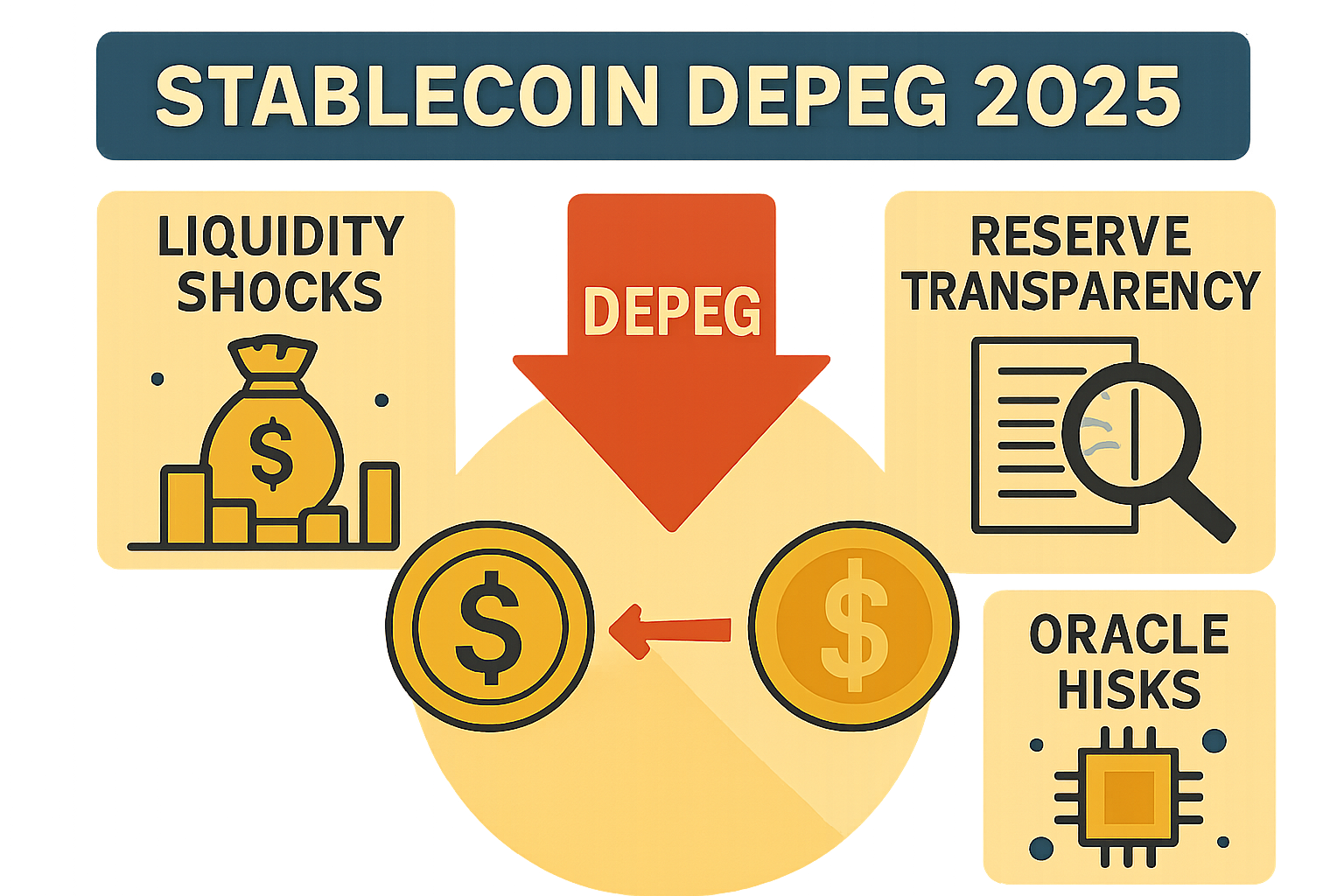
Stablecoins are designed to provide a digital asset with a stable value, most often pegged to the US dollar. Yet, as 2025 has made clear, even the most robust mechanisms can fail. When stablecoins lose their peg, sometimes by several percent or more, the consequences ripple across DeFi protocols, trading venues, and user portfolios. To understand why stablecoins lose their peg, we need to examine three primary risk vectors: liquidity shocks, reserve failures, and oracle risks. Each presents a distinct threat that can destabilize even well-known names in the space.
Liquidity Shocks: The First Domino in Depeg Events
Liquidity shock stablecoin events are often the initial trigger for depegging. When large-scale redemptions or market-wide sell-offs occur, they can rapidly drain liquidity pools supporting a stablecoin. This sudden outflow forces issuers or automated market makers to sell collateral at unfavorable prices, creating a feedback loop of falling confidence and accelerating redemptions.
A textbook case unfolded during recent crypto downturns when users rushed to exit positions en masse. As redemption requests outpaced available liquid reserves, prices deviated sharply from their target peg. For example, the March 2023 USDC incident, where $3.3 billion of reserves were locked at Silicon Valley Bank, led USDC to trade as much as 13% below its $1 target. DAI followed suit due to its exposure to USDC-backed collateral. Only after decisive intervention did both coins recover parity.
This scenario is not isolated: In November 2025 alone, nearly half a dozen decentralized stablecoins experienced significant depegs triggered by similar liquidity crunches (see case studies here). The lesson is clear: sufficient and accessible liquidity is foundational for peg stability.
Reserve Failures: When Collateral Isn’t Enough
The second major risk is reserve failure crypto. Stablecoins are only as strong as their underlying collateral and the transparency of those reserves. If reserves are inadequate, mismanaged, or opaque, such as insufficient collateralization or delayed attestations, market trust erodes rapidly.
This risk is especially acute for asset-backed coins facing increased regulatory scrutiny in 2025. Some projects have been caught holding risky or illiquid assets (like commercial paper) instead of cash or short-term treasuries. Any sign that reserves cannot be redeemed at par triggers panic selling and sharp depegs. Even minor delays in publishing attestation reports can create uncertainty and drive prices off their intended peg.
The search for higher yields often incentivizes issuers to hold less liquid assets, a structural conflict that can undermine stability when stress hits the system.
Oracle Risks: Data Integrity Under Siege
The third pillar of stablecoin depeg risks centers on oracle bug DeFi risk. Oracles feed real-world data (such as external asset prices) into smart contracts that govern stablecoins and lending protocols. If these feeds are compromised, via manipulation, smart contract bugs, or delayed updates, the result can be catastrophic mispricing.
Certain algorithmic and DeFi-native stablecoins have suffered severe depegs due to inaccurate price feeds. In May 2025, a Chainlink oracle malfunction on Avalanche led directly to $500,000 in erroneous liquidations involving deUSD positions. Earlier that year, an attacker exploited latency in ZKsync’s oracle updates with a flash loan attack on wUSDM, resulting in over $700,000 lost through artificial price inflation.
Oracle vulnerabilities remain one of the least understood yet most powerful drivers of systemic risk across decentralized finance platforms.
As the frequency and severity of these incidents increase, it’s clear that oracle risks are not just technical issues, they’re fundamental threats to the integrity of the entire DeFi ecosystem. The October 2025 crypto crash highlighted how a single compromised price feed can propagate across protocols, triggering widespread liquidations and compounding losses. This underscores why robust, decentralized oracle architectures and rigorous monitoring are now essential for any stablecoin protocol aiming for long-term resilience. For a deeper dive into real-world examples and mitigation strategies, see how oracle manipulation exploits trigger stablecoin depegs in DeFi.
Navigating the New Reality: Risk Management in 2025
Given this landscape, stablecoin risk management 2025 demands a multi-layered approach:
- Liquidity Monitoring: Track real-time liquidity pool health and redemption activity. Early detection of abnormal outflows is key to preempting peg instability.
- Transparent Reserve Audits: Insist on frequent, third-party attestations of reserves. Opaque or delayed reporting should be treated as a red flag for both retail and institutional participants.
- Diversified Oracle Systems: Favor protocols that use multiple independent oracles with robust fallback mechanisms. Single points of failure or excessive centralization amplify systemic risk.
The events of 2025 have made it clear: even short-lived depegs can trigger cascading liquidations across lending markets, DEXes, and yield protocols. For investors seeking practical protection strategies, including hedging via derivatives or protocol insurance, see our guide on how to hedge against depeg risk in DeFi.
Why Staying Informed Matters
The common thread across all three vectors provides liquidity shocks, reserve failures, and oracle risks: is that they often strike with little warning. By the time prices deviate significantly from their peg, opportunities to exit safely may have vanished. This reality makes proactive monitoring and education non-negotiable for anyone holding or building with stablecoins.
The rapid evolution of DeFi means new vulnerabilities will continue to emerge. However, by understanding these core failure modes, and leveraging tools designed for real-time risk analytics, investors can better safeguard their capital against future shocks. For an ongoing analysis of current depeg events and actionable insights on risk mitigation, bookmark DepegWatch. com as your trusted resource in the ever-shifting world of digital asset stability.
No comments yet. Be the first to share your thoughts!