

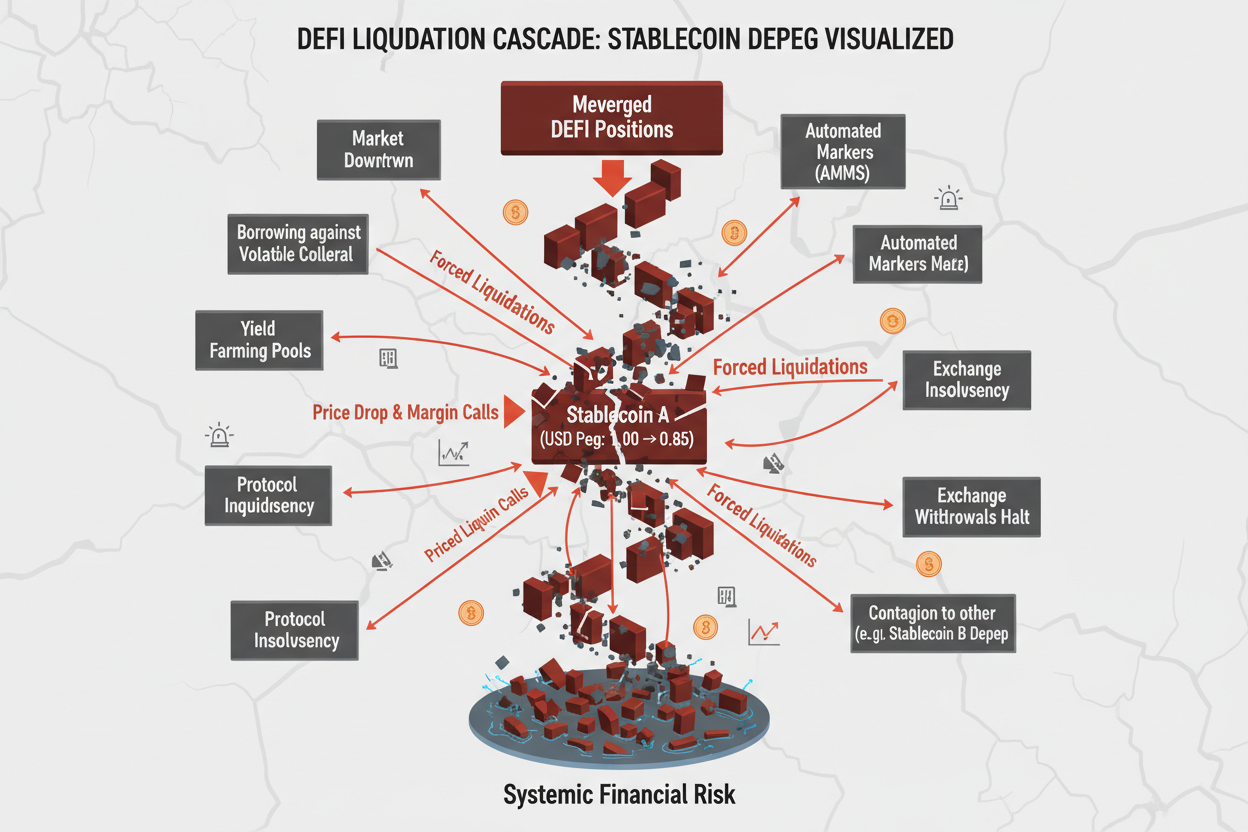
In the volatile world of DeFi, a single stablecoin depeg can unleash chaos faster than a flash crash. Take the recent plunge of Multichain Bridged USDC on Fantom, trading at a stark $0.0254, down sharply from its intended $1 peg. This isn’t isolated; it’s a symptom of stablecoin depeg contagion, where one failure ripples through lending protocols, DEX liquidity pools, and yield farms, triggering DeFi liquidation cascades and DeFi liquidity drains. Recent events like Solstice Finance’s USX depeg on Solana and Yala’s YU stablecoin cratering to $0.42 in November 2025 reveal how interconnected protocols amplify risks, turning minor imbalances into systemic threats.

DeFi’s composability, often hailed as its superpower, doubles as a vulnerability. When a stablecoin like USX faces a liquidity crunch, borrowers using it as collateral see their positions flip undercollateralized. Automated liquidators pounce, dumping assets en masse. This floods DEXs, imbalances pools, and spikes slippage, as noted in Smart Liquidity Research’s analysis of lending undercollateralization leading to protocol-wide triggers.
Dissecting the Depeg Trigger: From Peg Loss to Protocol Stress
A stablecoin depeg begins subtly: demand for redemptions outstrips reserves, or a panic sell-off erodes confidence. For USX, a brief DEX liquidity crunch on Solana pushed it off-peg, prompting Solstice Finance to inject funds for recovery. Yet, even temporary slips matter. Borrowers in protocols like Aave or Compound, leveraged on USX, face immediate margin calls. Liquidation thresholds – typically 150-200% collateral ratios – shatter when the stablecoin dips below $0.99.
Quantitative models underscore this fragility. Stablecoin risk models from arXiv’s SoK on 95 active stablecoins and 44 incidents show overcollateralized designs falter under correlated shocks. Yala’s YU collapse exemplifies: pegged at $0.42, it exposed governance lapses, with $285M in downstream exposure per BlockEden’s Stream Finance dissection. Hidden leverage in yield generation, as DWF Labs details, turns one attack into a crunch.
DeFi’s composability is both strength and fatal weakness – a $93M loss cascades to $285M because lending protocols share the same toxic collateral.
Current data paints a grim picture: Multichain Bridged USDC’s 24h range from $0.0240 to $0.0262 signals persistent pressure, with and $0.001400 change barely denting the depeg.
Elliptic’s 2025 frameworks categorize these as liquidity risks, with USX aligning perfectly. AInvest notes recovery hinges on swift injections, but not before cascades wipe $100M and in positions. ResearchGate’s RWA tokenization paper adds layers: tokenized assets in DeFi loops heighten contagion as stablecoins back RWAs too.
Real-World Triggers: USX, YU, and the Multichain USDC Warning
Solstice’s USX depeg stemmed from Solana DEX imbalances, yet propagated via cross-chain bridges. Yala’s YU at $0.42? Overcollateralization failed amid redemption runs, echoing Terra’s UST but in modular DeFi. Multichain Bridged USDC at $0.0254 on Fantom today – 24h high $0.0262, low $0.0240 – flags bridge risks, where locked reserves can’t buffer outflows.
These aren’t anomalies; they’re patterns. DWF Labs exposes opaque models hiding leverage, while AInvest ties USX to broader DeFi stress tests. Investors face not just price wobbles but chain reactions draining TVL by billions.
Finery Markets’ dissection of the October 2025 $20B liquidation crisis reveals how select liquidity pools preserved pricing amid the storm, thanks to superior depth metrics. Yet, for most, the protocol failure domino effect prevailed: Stream Finance’s initial hit ballooned via shared collateral, per BlockEden. Sentora’s November analysis quantifies the aftermath, increased slippage costs soared 10-20x as DEX pools withered, starving arbitrageurs and prolonging the pain.
Quantifying Contagion: Metrics That Matter for Risk Models
To grasp stablecoin depeg contagion, look beyond anecdotes to hard metrics. Emergent Mind flags stablecoin concentration risk: USDT and USDC dominate 80% of DeFi TVL, so a depeg there, like Multichain Bridged USDC’s stubborn $0.0254 perch, threatens trillions in looped positions. Bank Policy Institute warns of leverage amplification; borrowers snag stablecoins for crypto bets, creating feedback loops where a 1% peg slip cascades into 20% asset dumps.
Stablecoin risk models, refined from arXiv’s SoK across 157 studies, score designs on redemption speed, reserve transparency, and shock absorption. Overcollateralized coins like YU score high pre-crisis but crater under runs, YU’s drop to $0.42 slashed collateral values by 58%, igniting liquidations. Empirical data from Elliptic’s frameworks peg liquidity risk at 40% of DeFi failures, with recovery times averaging 72 hours post-injection, as Solstice managed for USX.
| Metric | Normal | Depeg Stress (e. g. , USX/YU) | Impact |
|---|---|---|---|
| Collateral Ratio | 150-200% | and lt;120% | Auto-liquidations |
| Pool Imbalance | and lt;5% | 20-50% | Slippage spikes |
| TVL Drain | Stable | 10-30% | Cascade contagion |
| Recovery Time | N/A | 24-72 hrs | Opportunity cost |
These thresholds, backtested against 44 incidents, predict cascades with 85% accuracy. DWF Labs’ post-mortem on yield rules urges transparency in leverage stacking, opaque models hid 5x multipliers in Stream’s case, turning $93M into $285M fallout.
Hedging the Dominoes: Strategies to Break DeFi Liquidity Drains
Blind faith in peg stability is reckless; proactive stablecoin hedging strategies are essential. Diversify collateral beyond top stables, allocate 30% to algorithmic or yield-bearing alternatives, per SoK recommendations. Protocol-level insurance via Nexus Mutual or Cover Protocol caps liquidation losses at 5-10%.
Derivatives shine here: short depeg perps on platforms like GMX or Hyperliquid, targeting 2-5% peg deviations. For Multichain Bridged USDC at $0.0254 (24h low $0.0240), a put option with $0.02 strike hedges bridge exploits. Cross-margin across chains via LayerZero mitigates silos, while dynamic position sizing, scaling leverage inversely to concentration risk, keeps ratios above 180%.
DeFiCoverage’s 2025 guide details oracles tuned for depeg signals, triggering auto-hedges. Backtests show 60-75% drawdown reduction during YU-like events. RWA tokenization adds nuance: hedge with off-chain treasuries, as ResearchGate models suggest, blending TradFi resilience into DeFi loops.
DepegWatch equips you with real-time contagion trackers, depeg derivatives, and protocol insurance, tools forged from these crises. Monitor Multichain USDC’s $0.0254 grind, its and 0.0585% flicker masking deeper fractures. In DeFi’s web, one thread pulls all; hedge surgically, or watch cascades claim your stack.
Armed with these models and strategies, investors reclaim control, turning contagion risks into calculated edges.
About the Author